


Sign up to become a sk.in insider
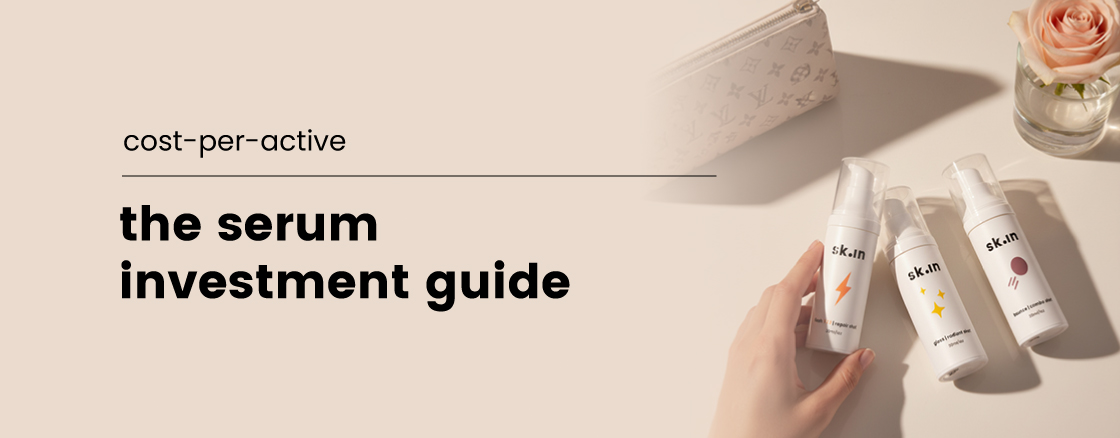

The Serum Investment Guide: What Cost-Per-Active Reveals About Real Skincare Value
TL;DR:
The true value of a serum lies not in its price but in the concentration, stability, and formulation quality of its active ingredients relative to what you pay per use.
The true value of a serum lies not in its price but in the concentration, stability, and formulation quality of its active ingredients relative to what you pay per use.
- Price does not equal potency: a serum’s retail cost reflects many inputs, from packaging and distribution to research and testing, and the active ingredients are only one of them.
- Cost-per-active is a more useful measure than cost-per-ml: weigh what you pay per use against the number of relevant actives present at functional concentrations.
- Ingredient position on the ingredient list and the presence of a disclosed concentration are the two fastest ways to assess whether an active is present at a working level.
- Formulation quality, not just ingredient selection, determines whether an active reaches your skin at the depth and stability required to do anything measurable.
- Published, independent study data gives you a firmer basis for a buying decision than any description on the front of the box.
A serum’s price tag does not determine its value. Real value is judged by weighing the cost per use against the concentration, form and stability of the active ingredients delivered. Two serums at very different prices can deliver the same working active; two at the same price can deliver very different amounts of it. Cost-per-active is how you tell.
A serum’s price tag does not determine its value. This serum investment guide shows you how to judge what you are paying for: real value is a question of the concentration, form and stability of the active ingredients delivered, weighed against the cost per use. Two serums at very different prices can deliver the same working active, and two at the same price can deliver very different amounts of it. Cost-per-active is how you tell the difference.
Understanding this distinction is what turns a serum purchase from a guess into a decision. The framework below is a practical way to evaluate any serum before you buy, and it explains why cost-per-active is a more useful measure than cost-per-ml.
Why Serum Pricing Is Not a Reliable Guide to Serum Quality
What Goes Into the Retail Price of a Serum?
The retail price of a serum is a composite of many legitimate costs, decided long before the product reaches your skin. Some sit inside the bottle: sourcing the actives, the form they are bought in, the stabilising and pH work that keeps them potent, and any independent testing of the finished formula. Others sit around it: packaging, distribution, retailer margins, import duties where a product crosses a border, and the cost of building and running a brand. Every serum carries some mix of both.
The point for you as a buyer is simply that the shelf price does not tell you the mix. Two serums at the same price can allocate it quite differently, and neither allocation is visible from the front of the box. What is visible, if you know where to look, is the ingredient list and any disclosed concentrations, and those tell you about the part of the price that reaches your skin.
Price and Formulation Are Two Separate Questions
Price tells you what a serum costs. Formulation tells you what it does. The two often travel together, and a higher price can reflect real formulation investment, but they are separate questions, and the useful habit is to ask the second one on its own.
A well-formulated serum prioritises active integrity, which means the potency of an ingredient is preserved from formulation through to application. It selects actives for their compatibility with one another and with your skin’s natural protective function. It doses those actives at concentrations that correspond to evidence.
So before any serum purchase, at any price, the question worth asking is: what in this formula is doing the work, and how much of it is there?
What Is Cost-Per-Active and How Do You Calculate It?
How to Calculate Cost Per Use in Skincare
Cost per use is calculated by dividing the retail price of a serum by the number of applications the bottle yields. A 30ml serum applied twice daily at three to four drops per application typically delivers between 150 and 200 uses. Dividing the retail price by that number gives a cost per application figure that is far more useful than the headline price.
A serum priced at R650 for 30ml, yielding 175 uses, costs approximately R3.71 per application. A serum priced at R1,200 for the same volume at the same application rate costs approximately R6.86 per application. The price difference is significant. Whether the formulation difference justifies it is the question cost-per-active is designed to answer.
One refinement matters for a treatment serum used once or twice a week rather than daily. A 30ml bottle used at that cadence lasts many months, so the cost per application can be very low even where the shelf price is not. Always calculate from the product’s own intended frequency, not from a daily assumption.
Why Active Concentration Changes the Calculation Entirely
Cost per use tells you what you spend per application. Cost-per-active tells you what you receive per application. The distinction matters because a serum can cost R3.71 per use and deliver almost nothing if its actives are present at sub-functional concentrations.
Cost-per-active is not a single calculable number in the way cost per use is. It is a qualitative assessment: for what you pay per application, how many relevant actives are present, at what concentration, in a formulation that supports their stability and delivery? A serum with two or three well-dosed actives generally offers stronger cost-per-active value than one with a long ingredient list where most of the named actives sit near the bottom at trace levels, whatever either of them costs.
How to Read a Serum Ingredient List Before Buying
Understanding INCI Order and What It Tells You About a Formula
The ingredient list on a product follows a set order by law (the INCI list, from International Nomenclature of Cosmetic Ingredients). Ingredients above one percent must be listed in descending order of concentration, from highest to lowest. This ordering is one of the most useful tools available to you as an informed buyer.
Water (aqua) typically appears first in most serums, as it forms the base of the formulation. The actives that follow immediately afterwards are present at the highest concentrations in the formula. An active appearing in the final third of a long ingredient list is almost certainly present at a concentration below one percent. For many actives that is below the level at which they produce a measurable effect, although a small number of potent actives are formulated to work below one percent by design, which is why percentage disclosure matters as a second check.
Reading the list from the bottom up, rather than scanning the front of the packaging, gives you a more accurate picture of what a formula actually contains.
How to Tell If an Active Is Present at a Working Level
An active at a working level is present at a concentration sufficient to interact with your skin in a way that produces a visible or measurable outcome. An active at a trace level appears on the ingredient list but is present in too small an amount to do anything meaningful. Both are common, and the list tells you which is which.
Two signals help distinguish between them. First, position on the list: actives appearing after the preservative system are almost certainly present below one percent. Second, percentage disclosure: where a concentration is printed, you can check it against the evidence for that active. Where it is not, the list position is your only guide, and it is worth weighing the purchase accordingly.
Ingredient compatibility is also relevant here. An active present at a functional concentration can still underperform if the formulation pH, carrier system, or co-ingredients compromise its stability or delivery.
Skincare Formulation Cost Explained: Where the Money Goes Inside the Bottle
Why Some Actives Are Inherently More Expensive to Source and Stabilise
Not all actives cost the same to include at effective concentrations. An oil-soluble form of vitamin C (ascorbyl tetraisopalmitate) is significantly more expensive than basic ascorbic acid, and its inclusion reflects a deliberate formulation decision to prioritise stability over cost efficiency. HPR (Hydroxypinacolone Retinoate), a form of vitamin A that works without the multi-step conversion ordinary retinol needs (a retinoid ester), requires specific pH and carrier conditions to maintain active integrity through manufacture, packaging, and shelf life.
Hyaluronic acid (a moisture-binding molecule) formulated across multiple molecular weights, so that it addresses the hydration gradient at different skin depths, costs more to source and blend than a single-weight hyaluronic acid at a lower concentration. These formulation decisions are invisible on the front of the packaging but are legible in the ingredient list and in independently measured outcomes.
The Hidden Cost of Poor Ingredient Compatibility
Ingredient compatibility determines how actives interact without compromising each other or your skin’s natural protective function. A formula that combines actives without accounting for their pH requirements, their oxidation sensitivity, or their interaction with preservative systems may present a compelling ingredient list whilst delivering compromised active integrity at the point of application.
This is a cost that lands on the user rather than appearing on the label. Poor ingredient compatibility does not necessarily make a product unsafe. It makes it less effective than its ingredient list suggests it should be. The investment in formulation expertise, in understanding which actives can coexist at effective concentrations and which cannot, is one of the least visible and most consequential costs in performance skincare development.
Serum Price Versus Active Concentration: A Practical Comparison Framework
How to Judge Whether a Serum Justifies Its Price
A serum justifies its price when four criteria are met. First, the key actives appear in the upper half of the ingredient list or the brand discloses their concentration. Second, the formulation accounts for the stability and delivery requirements of those actives. Third, the product has been independently tested with published results from a named testing facility, a defined study duration, and a specific measured outcome. Fourth, the cost per use, relative to the active concentration and formulation quality, is reasonable for the skin concern being addressed.
A serum that meets all four criteria offers stronger value than one that meets only the first, at whatever price each is sold. The presence of independent instrumental data is particularly significant: it gives you a measured outcome to weigh instead of a description.
Understanding Serum Pricing in the South African Context
Serum pricing in South Africa is shaped by factors beyond formulation quality. Import duties, distribution margins, currency fluctuation, and the cost of complying with local regulatory requirements all influence the retail price of imported products. For a locally formulated serum, those import costs do not apply, so a larger share of the price can sit in formulation and testing. For an imported one, the formulation may be equally sound and the price simply carries the journey.
Neither origin is better by default. What matters is that you can see the formulation and the testing behind a product, because those are the parts of the price that reach your skin. In a market where import costs are a real part of many prices, cost-per-active analysis is an especially practical tool.
How to Budget for Skincare Actives Without Compromising on Efficacy
How Much Should You Spend on a Serum?
There is no universal answer to this question. Spend should be proportionate to the specificity and measurability of the skin concern being addressed.
For a targeted concern such as visible changes in skin texture, uneven tone, or shifts in elasticity, a serum with independently tested actives at documented concentrations gives you the clearest basis for expecting a visible outcome. For a general hydration concern, a well-formulated serum with multi-weight hyaluronic acid at a moderate price point may offer everything your skin requires.
The question is not how much to spend in absolute terms. It is whether the formulation justifies what is being charged, relative to the concern being addressed.
Serum Cost Per Month Explained: A More Useful Way to Think About Spend
Monthly cost is a more useful budgeting frame than retail price. A 30ml daily-use serum applied once or twice daily typically lasts between four and six weeks. Calculating the monthly cost involves dividing the retail price by the number of weeks the bottle lasts, then multiplying by four.
A serum that costs R800 and lasts six weeks costs approximately R533 per month. A serum that costs R500 and lasts three weeks costs approximately R667 per month. The cheaper product costs more per month. This is not an unusual finding: application rate, bottle volume, and formulation concentration all affect how long a product lasts and therefore what it costs to use. A treatment serum used once or twice weekly lasts far longer again, and its monthly cost is correspondingly lower than its shelf price suggests.
Monthly cost, combined with cost-per-active assessment, gives a far more accurate picture of skincare spend than retail price comparison alone.
What Makes sk.in a Considered Serum Investment
sk.in is a South African performance skincare brand built around a serum-first approach and a barrier-first formulation philosophy. Every serum in the range is formulated by Dr Alek Nikolic, an aesthetic medical practitioner with over two decades of clinical experience. That formulation authority reflects two decades of observing how skin responds to actives in clinical settings, applied to precision dosing decisions.
Each sk.in serum is ingredient-engineered for compatibility and efficacy. Active selection is guided by ingredient compatibility, molecular weight awareness, and the potency-tolerance balance. The goal is to ensure that actives reach your skin at the depth and stability required to produce a visible outcome, without compromising barrier integrity. Every concentration is printed on the bottle, so the percentage check described above can be run on any sk.in serum in a few seconds.
The daily-use serums have been independently tested by Luamed (Slovenia, 2019) against EU Cosmetic Regulation 1223/2009 and Cosmetics Europe (COLIPA) efficacy guidelines, using the Callegari 1930 Soft Plus instrumental device. Each study ran for 8 weeks on 10 volunteers, with treated and matched control zones on the same face. Outcomes include hydration measured at 1, 3 and 5 hours after a single application for sk.in marvel │ hydro shot, the strongest 8-week elasticity result in the range for sk.in flash │ restore shot (flash 2), and measurable reductions in skin melanin levels at 4 and 8 weeks for sk.in bounce │ combo shot. These are specific, published results from a named third-party testing facility with a defined study duration and measured parameters, so the four-criteria check above can be run on sk.in in full. The sk.in avenge range is the high-intensity treatment layer, used once or twice weekly, and is positioned on its formulation: the concentration, form and stability of a single active, precision-dosed for skin that has built tolerance.
In cost-per-active terms, a doctor-formulated serum with disclosed concentrations, precision-dosed actives, and ingredient compatibility built into the formulation represents a considered investment. Where to start depends on your skin: the decision guide by skin concern and barrier status walks through that choice, and the guide to introducing a second serum covers what the percentage on a label tells you and how to build a routine at the right pace.
Explore the sk.in range at skiningredients.com to review active concentrations, formulation rationale, and independently tested outcomes before making your next serum decision.
Frequently Asked Questions About Serum Value and Formulation Cost
Q: Is a more expensive serum always worth the price?
Not necessarily. A higher price reflects many inputs, of which the active ingredients are only one. A serum is worth its price when the active ingredients are present at functional concentrations, the formulation supports their stability and delivery, and the cost per use is reasonable relative to the skin concern being addressed.
Q: How do I calculate cost per use for a serum?
Divide the retail price of the serum by the number of uses in the bottle. A 30ml serum used twice daily at roughly 3 to 4 drops per application typically yields between 150 and 200 uses. Divide the retail price by that number to get your cost per use, then compare that figure against the active concentration and formulation quality to assess real value. For a treatment serum used once or twice weekly, calculate from that frequency instead.
Q: What does cost-per-active mean in skincare?
Cost-per-active evaluates serum value by considering not just the price per use but the quality, concentration, and stability of the active ingredients you are paying for per application. A serum with three well-dosed actives at a moderate price may offer better cost-per-active value than a serum with a long ingredient list where most actives appear in trace amounts.
Q: How can I tell if an active ingredient is present at an effective concentration?
Look for the ingredient’s position on the ingredient list: ingredients above one percent are listed in descending order of concentration. An active appearing near the bottom of a long list is likely present below one percent. Where a brand discloses the percentage of an active, that transparency is a positive signal. Absence of any percentage disclosure warrants further scrutiny.
Q: What makes a serum expensive to formulate?
Certain actives are inherently costly to source, stabilise, and deliver at effective concentrations. An oil-soluble form of vitamin C (ascorbyl tetraisopalmitate), HPR (Hydroxypinacolone Retinoate), and multi-weight hyaluronic acid complexes require specific formulation conditions to remain active from manufacture through to application. pH management and preservative systems that protect active integrity also add to formulation cost.
Q: How do I know if a serum has been independently tested?
Look for references to third-party instrumental testing with a named testing facility, a defined study duration, and a specific measured outcome. A general phrase without study details is not the same as published instrumental data. Specific testing credentials give you a firmer basis for confidence.
Q: How much should I realistically spend on a serum each month?
Calculate the cost per use first, then assess whether the active concentration and formulation quality justify that figure for the skin concern you are addressing. A well-formulated 30ml daily-use serum typically lasts between four and six weeks. Monthly cost is a more useful budgeting frame than retail price comparison.
Q: What should I look for when evaluating a serum before buying?
Prioritise four things: the position of key actives on the ingredient list, whether the brand discloses active concentrations, whether the product has been independently tested with published results, and whether the formulation accounts for ingredient compatibility. A serum that scores well on all four criteria is a more reliable investment than one you can judge only by the front of the box.
Related Articles
- Which sk.in Serum to Start With: A Decision Guide by Skin Concern and Barrier Status
Cluster article: which serum to begin with, by skin concern and barrier status. - How to Introduce a Second Serum Without Overwhelming Your Routine
Cluster article: what the percentage on the label tells you, how to layer, and how to introduce a second active at its own cadence.
You must be logged in to post a comment.