

Sign up to become a sk.in insider
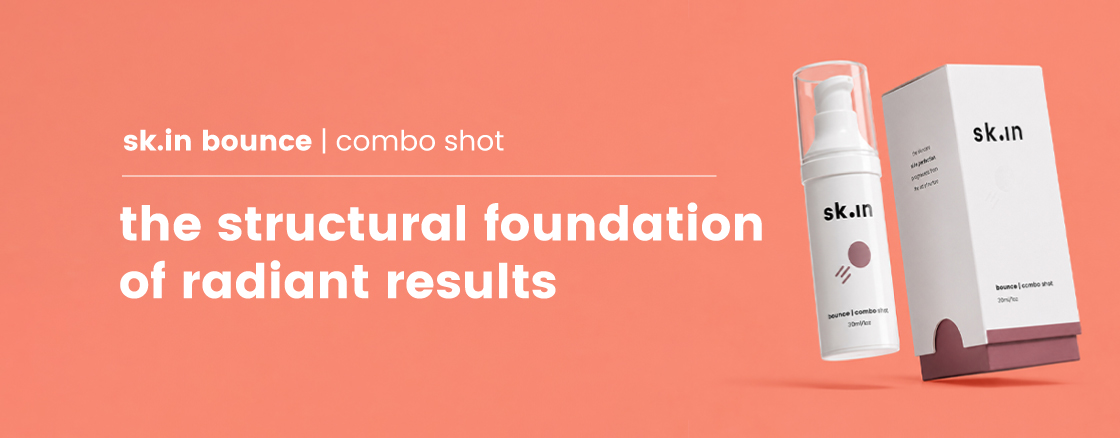

Why sk.in bounce | combo shot Is the Structural Foundation of a Radiant Result
TL;DR:
sk.in bounce | combo shot earns its position as the structural foundation of a radiant result because it addresses elasticity, pigmentation, and pore appearance through a single, clinically informed retinoid ester formulation that is independently tested and barrier-compatible.
sk.in bounce | combo shot earns its position as the structural foundation of a radiant result because it addresses elasticity, pigmentation, and pore appearance through a single, clinically informed retinoid ester formulation that is independently tested and barrier-compatible.
- sk.in bounce | combo shot is built around HPR (Hydroxypinacolone Retinoate), a retinoid ester distinct from retinol in both mechanism and skin tolerance profile.
- Skin elasticity and surface texture are structural preconditions for radiance, sk.in bounce addresses both within a single, barrier-compatible formulation.
- Independent 8-week instrumental testing at Luamed (Slovenia, 2019) confirmed measurable improvement in skin melanin levels, supporting its use for pigmentation-concerned skin.
- Granactive Retinol is the commercial name for an HPR-based complex; understanding what it is clarifies why sk.in bounce suits skin types that have struggled with traditional retinoids.
- Tolerance building is not optional with any retinoid, the article outlines a structured introduction protocol that protects barrier integrity whilst allowing the active to work.
sk.in bounce | combo shot is formulated around HPR (Hydroxypinacolone Retinoate), a retinoid ester that supports cellular turnover with lower irritation potential than traditional retinol. In independent 8-week instrumental testing at Luamed (Slovenia, 2019), it helped reduce the appearance of pigmentation and supports skin elasticity, addressing the structural conditions that underpin a visibly radiant result.
Radiance is not a surface phenomenon. It is the visible consequence of structural skin conditions working in concert: consistent cellular turnover, intact barrier integrity, supported elasticity, and a skin surface refined enough to reflect light evenly. When any one of these conditions falters, the result registers as dullness, uneven tone, or a loss of the firmness that gives skin its characteristic glow.
sk.in bounce | combo shot is formulated around HPR (Hydroxypinacolone Retinoate), a retinoid ester that supports cellular turnover with lower irritation potential than traditional retinol. In independent 8-week instrumental testing at Luamed (Slovenia, 2019), it helped reduce the appearance of pigmentation and supports skin elasticity, addressing the structural conditions that underpin a visibly radiant result.
Understanding why this formulation works requires moving past the surface-level conversation about retinoids and into the structural logic of what skin actually needs to look radiant. The parent article, The Glow Serum Explained: what actually makes skin look radiant, covers the physics of light reflection and the barrier’s role in radiance. This article goes deeper into the specific structural mechanisms that sk.in bounce | combo shot addresses, and why its formulation logic makes it the structural foundation of a measurably radiant result.
sk.in is a South African performance skincare brand, doctor-formulated by Dr Alek Nikolic, an aesthetic medical practitioner with over two decades of clinical experience. Every serum in the range is ingredient-engineered for compatibility and efficacy, with precision dosing ensuring that potency and skin tolerance coexist. sk.in bounce | combo shot is the product in the range built specifically around retinoid-driven structural support, and the reasoning behind that formulation deserves a precise, ingredient-level examination.
—
What Causes Loss of Skin Elasticity and Why It Matters for Radiance
Skin elasticity is the capacity of skin to return to its original position after deformation. It is governed primarily by the structural proteins elastin and collagen within the dermis, alongside the extracellular matrix that supports them. As skin ages, and as it is exposed to cumulative environmental stress, the synthesis of these structural proteins slows whilst their degradation continues.
The visible result is not simply the appearance of lines. It is a change in the three-dimensional architecture of the skin surface, which directly affects how light behaves on contact.
How Elasticity Loss Changes the Way Skin Reflects Light
Skin with intact elasticity maintains a relatively consistent surface geometry. Light strikes it and scatters in a controlled, even pattern. When elasticity declines, the skin surface becomes less uniform at a microscopic level: fine lines deepen, pores appear more prominent, and the skin loses the subtle plumpness that contributes to that characteristic luminosity.
This is not merely a cosmetic observation. The relationship between surface geometry and light reflection is structural. Skin that has lost elasticity reflects light less evenly, and the result registers as dullness rather than glow, regardless of how well hydrated the surface may be. This is why addressing elasticity is not a secondary concern in a radiance-focused routine. It is foundational.
Autumn and winter light can make this more apparent. The lower angle and cooler quality of seasonal light tends to reveal textural irregularities more clearly than the diffuse warmth of summer. If you have noticed your skin looking less luminous as the seasons change, the structural explanation is worth exploring further in Why Autumn Light Reveals What Your Skin Is Really Reflecting.
The Structural Skin Support Ingredients That Address Elasticity at a Formulation Level
Retinoids are the most evidence-supported class of ingredients for addressing elasticity at a structural level within cosmeceutical formulation. They work by interacting with nuclear retinoic acid receptors in skin cells, influencing gene expression related to cellular turnover and extracellular matrix maintenance.
The outcome of consistent retinoid use, over time and at appropriate concentrations, includes a refinement of surface texture, a visible reduction in the appearance of fine lines, and support for the structural conditions that underpin elasticity. In independent 8-week instrumental testing at Luamed (Slovenia, 2019), sk.in bounce | combo shot confirmed support for skin elasticity, providing measured data rather than a marketing position.
The precision dosing within this formulation is deliberate. The goal is not the highest possible concentration, but the concentration at which the retinoid delivers measurable structural support whilst maintaining barrier integrity across a broad range of skin types.
—
What Is Granactive Retinol and How Does HPR Differ from Traditional Retinol?
The term “Granactive Retinol” refers to a commercial delivery system developed to improve the tolerability and stability of retinoid actives. It is not a single ingredient. It is a formulation complex that typically contains HPR (Hydroxypinacolone Retinoate) in a carrier system designed to enhance skin penetration whilst reducing the irritation associated with traditional retinol.
Understanding the distinction between HPR and retinol is essential for anyone making an informed formulation choice.
Why HPR (Hydroxypinacolone Retinoate) Is a Retinoid Ester, Not a Retinol
Traditional retinol must undergo a two-step conversion process within the skin before it becomes biologically active as retinoic acid. Retinol converts first to retinaldehyde, then to retinoic acid. Each conversion step introduces the potential for irritation, as the intermediate compounds and the final retinoic acid itself can provoke a sensitisation response, particularly in skin with compromised barrier integrity.
HPR (Hydroxypinacolone Retinoate) is a retinoid ester that binds directly to retinoic acid receptors without requiring the same multi-step conversion. This is the mechanistic reason for its lower irritation profile. It is not a diluted or weaker form of retinol. It is a structurally different molecule that interacts with the same receptors via a more direct pathway.
This distinction matters for formulation integrity. A retinoid that requires fewer conversion steps to reach biological activity is not only better tolerated by the skin, it is also more stable within the formulation itself, which supports active integrity from the point of manufacture through to application.
Why a Gentle Retinoid for Sensitive Skin Is Not a Compromise in Efficacy
The assumption that tolerability and efficacy exist in opposition is one of the more persistent misconceptions in skincare. In the context of retinoids, the evidence does not support this assumption.
HPR (Hydroxypinacolone Retinoate) delivers retinoid activity at the receptor level without the conversion-related irritation of traditional retinol. For skin that is reactive, barrier-compromised, or simply new to retinoid use, this means the same structural support can be accessed without the peeling, redness, and transient barrier disruption that often accompanies traditional retinol introduction.
The barrier-first formulation philosophy at sk.in is grounded in this understanding. An active that compromises barrier integrity in order to deliver its benefit is a formulation that undermines itself. HPR, at the precision-dosed concentration used in sk.in bounce | combo shot, supports cellular turnover and elasticity without requiring the skin to tolerate a period of significant disruption.
—
How sk.in bounce | combo shot Addresses Pores, Texture, Pigmentation, and Firmness in One Serum
The question of whether a single serum can meaningfully address multiple skin concerns is a reasonable one. The answer lies in understanding whether those concerns share a structural root, or whether they are genuinely independent problems requiring independent solutions.
In the case of pores, surface texture, pigmentation, and firmness, the structural root is largely shared: inconsistent cellular turnover, reduced elasticity, and an accumulation of keratinised cells at the surface that disrupts even light reflection and contributes to the appearance of enlarged pores and uneven tone.
How to Reduce the Appearance of Pores with a Retinoid Serum
Pore size is anatomically fixed. What changes is the appearance of pores, and that appearance is influenced by two primary factors: the accumulation of material within the pore lining, and the loss of the surrounding skin’s structural support.
Retinoids support cellular turnover, which means the rate at which keratinised cells are shed from the pore lining and the skin surface is increased. This helps reduce the accumulation that makes pores appear larger. Simultaneously, by supporting elasticity in the surrounding skin, retinoids contribute to the appearance of tighter, more refined pores over time.
This is not a surface-level effect. It is a structural one, which is why consistent use over a measured period produces more visible results than short-term application.
Serum for Firmness and Pigmentation: Why These Concerns Share a Structural Root
Pigmentation and firmness concerns are often treated as separate categories requiring separate products. At a formulation level, they are more closely related than that framing suggests.
Pigmentation irregularities, particularly those associated with cumulative sun exposure, are linked to dysregulated melanocyte activity and a slowing of the cellular turnover cycle that would ordinarily move pigmented cells towards the surface and away from the skin. When turnover slows, pigmentation accumulates and becomes more visible.
Retinoids support the normalisation of cellular turnover, which contributes to a more even distribution of pigmentation over time. In independent 8-week instrumental testing at Luamed (Slovenia, 2019), sk.in bounce | combo shot confirmed a measurable reduction in the appearance of pigmentation. This is not a claim extrapolated from ingredient theory. It is an instrumentally measured outcome.
Firmness concerns, as established above, are rooted in elasticity. The same retinoid mechanism that supports turnover also supports the structural conditions that underpin the appearance of firmness. One formulation, one structural mechanism, multiple visible outcomes.
—
How Often Should You Use a Retinoid Serum and How Do You Build Tolerance Correctly?
Frequency is one of the most consequential variables in retinoid use. Introducing a retinoid too quickly, or at too high a frequency before the skin has adapted, is the most common reason for the irritation, redness, and barrier disruption that gives retinoids their reputation for being difficult to use.
The appropriate introduction frequency for sk.in bounce | combo shot is two to three applications per week during an initial period of four to six weeks. This is not a conservative position taken to avoid efficacy. It is the protocol that allows the skin to build tolerance without compromising barrier integrity during the adaptation phase.
A Tolerance-Building Retinoid Routine That Protects Barrier Integrity
The tolerance-building protocol for a retinoid serum follows a clear logic. Begin with two applications per week, applied to clean, dry skin in the evening. Ensure that the skin is fully dry before application, as applying a retinoid to damp skin increases absorption rate and, with it, the potential for irritation.
After four to six weeks of twice-weekly use without notable irritation, frequency can be increased to three to four times per week. Skin that has built tolerance comfortably at this stage may progress to nightly use, though nightly use is not a requirement for measurable results.
During the tolerance-building period, pairing sk.in bounce | combo shot with a serum that supports barrier function is a sound formulation decision. Layering intelligence matters here: the retinoid serum should be applied before a hydrating or barrier-supporting serum, allowing each active to reach the skin at the appropriate depth without interference.
How Does Elasticity Affect Radiance and When Should You Expect to See a Measurable Change?
The relationship between elasticity and radiance is structural, as established earlier in this article. The timeline for measurable change is equally important to understand, because unrealistic expectations are one of the primary reasons people discontinue retinoid use before results become visible.
Cellular turnover operates on a cycle of approximately four weeks in younger skin, extending to six weeks or more as skin ages. A retinoid must support several complete turnover cycles before the structural changes it induces become visible at the surface. This is why the Luamed testing period was eight weeks, and why results confirmed at that point represent a meaningful clinical benchmark.
In independent 8-week instrumental testing at Luamed (Slovenia, 2019), sk.in bounce | combo shot confirmed measurable support for skin elasticity. Eight weeks of consistent, correctly-dosed use is the evidence-based timeframe within which visible structural change becomes measurable.
—
Why sk.in bounce | combo shot Is Formulated as a Night Serum for Elasticity and Glow
The recommendation to use sk.in bounce | combo shot at night is not a precautionary afterthought. It is part of the formulation logic, grounded in both the photosensitivity profile of retinoid esters and the biological conditions of night-time skin.
Retinoids, including HPR (Hydroxypinacolone Retinoate), are susceptible to photodegradation. Exposure to UV radiation can reduce the stability and therefore the active integrity of the retinoid within the formulation. Night application removes this variable entirely, ensuring the active reaches the skin in its intended state.
Retinoid Ester Benefits at Night: Why Application Timing Is Part of the Formulation Logic
Skin at night is in a physiologically distinct state from skin during the day. Transepidermal water loss increases slightly during sleep, and the skin’s cellular activity, including the processes that retinoids influence, is more active in the evening and overnight hours. This is not a marketing construct. It is a recognised aspect of circadian skin biology.
Formulating sk.in bounce | combo shot for night use aligns the retinoid’s mechanism of action with the skin’s own biological rhythm. The active is applied when the skin is most receptive to the cellular turnover signals it delivers, and without the competing variable of UV exposure that would degrade both the active and the skin surface simultaneously.
This is also the reason that daily SPF use is non-negotiable when introducing any retinoid into a routine. The retinoid itself does not increase photosensitivity in a significant clinical sense, but the accelerated cellular turnover it supports means that fresher, less photoprotected cells are present at the skin surface. Protecting those cells during daylight hours is part of responsible retinoid use.
What the Luamed Independent Testing Confirmed About sk.in bounce
The independent 8-week instrumental testing conducted at Luamed (Slovenia, 2019) provides the measured foundation for the claims made about sk.in bounce | combo shot. The testing was conducted against EU Cosmetic Regulation 1223/2009, which establishes the regulatory framework within which cosmetic claims must be substantiated.
The confirmed outcomes from that testing include a measurable reduction in the appearance of pigmentation and confirmed support for skin elasticity. These are instrumentally measured results, not consumer perception scores. They represent the structural changes that the formulation is designed to deliver, measured objectively over a clinically relevant timeframe.
The significance of this data extends beyond a single product. It reflects the broader formulation philosophy at sk.in: that precision dosing, ingredient compatibility, and barrier-first formulation principles produce serums that deliver measurable results without requiring the skin to tolerate an unreasonable level of disruption.
—
The Structural Case for sk.in bounce | combo shot
Radiance is earned at a structural level. It is the visible outcome of skin that turns over consistently, reflects light evenly, maintains its elasticity, and manages pigmentation distribution effectively. These are not independent concerns. They are interconnected structural conditions, and they respond to a retinoid formulation that addresses them at their shared root.
sk.in bounce | combo shot is built around HPR (Hydroxypinacolone Retinoate), a retinoid ester that delivers retinoid activity directly at the receptor level, without the multi-step conversion and associated irritation of traditional retinol. Its precision-dosed formulation supports cellular turnover, skin elasticity, the appearance of pores and texture, and a more even distribution of pigmentation, all confirmed in independent 8-week instrumental testing at Luamed (Slovenia, 2019).
The formulation is not attempting to address multiple concerns by combining multiple actives. It is addressing multiple concerns because those concerns share a structural origin, and HPR (Hydroxypinacolone Retinoate) acts at that origin with measurable precision.
For skin that is new to retinoids, the tolerance-building protocol is straightforward: begin at twice-weekly application, allow four to six weeks for adaptation, and increase frequency gradually. For skin that has previously experienced irritation from traditional retinol, the retinoid ester pathway offers the same structural support via a more direct and better-tolerated mechanism.
The result, over eight weeks of consistent use, is not a surface-level change. It is a structural improvement in the conditions that make skin look radiant, confirmed by independent instrumental measurement rather than adjective.
If you are building a routine around measurable structural outcomes, sk.in bounce | combo shot is the evidence-based starting point.
Frequently Asked Questions
What is Granactive Retinol and is it the same as retinol?
Granactive Retinol is the commercial name for a complex built around HPR (Hydroxypinacolone Retinoate), a retinoid ester. It is not the same molecule as retinol. HPR works more directly at the receptor level than retinol and does not require the same conversion steps in the skin, which is part of why it carries a lower irritation potential whilst remaining an efficacious retinoid active.
How often should I use a retinoid serum if I have sensitive or reactive skin?
Skincare professionals generally recommend beginning with two to three applications per week, applied at night, and increasing frequency gradually over four to six weeks as the skin demonstrates tolerance. This approach, known as tolerance building, allows the skin to adapt without compromising barrier integrity. sk.in bounce | combo shot is formulated with HPR rather than traditional retinol, which supports this process by reducing the likelihood of initial reactivity.
Can one serum really address pores, texture, pigmentation, and firmness at the same time?
When the formulation is built around an active that influences cellular turnover at a structural level, multiple visible concerns can improve through a shared mechanism. HPR (Hydroxypinacolone Retinoate) supports the rate and quality of surface cell renewal, which affects how pores appear, how evenly pigment is distributed, and how the skin surface reflects light. sk.in bounce | combo shot is formulated around this principle, confirmed in independent 8-week instrumental testing at Luamed (Slovenia, 2019).
Is HPR better than retinol for mature or elasticity-concerned skin?
HPR (Hydroxypinacolone Retinoate) is a retinoid ester that binds directly to retinoid receptors without requiring the multi-step conversion that retinol undergoes in the skin. Research suggests this more direct pathway results in efficacy with a lower irritation burden, which is particularly relevant for mature skin where barrier integrity is already under greater structural pressure. sk.in bounce | combo shot supports skin elasticity over 8 weeks of daily use, instrumentally measured.
Why is sk.in bounce | combo shot recommended as a night serum rather than a daytime serum?
Retinoid esters, including HPR, increase the skin’s sensitivity to ultraviolet exposure during active use. Applying sk.in bounce | combo shot at night aligns with this photosensitivity consideration and also coincides with the skin’s natural nocturnal cellular renewal cycle. This timing is not incidental, it is part of the formulation logic that makes the active most effective and most compatible with barrier integrity.
How does elasticity affect the way skin looks and reflects light?
Skin with supported elasticity maintains a more even surface architecture, which allows light to scatter and reflect more uniformly. As elasticity declines, the skin surface becomes less consistent in texture and tension, creating micro-irregularities that diffuse light unevenly and contribute to a visually flat or dull appearance. Addressing elasticity structurally is therefore a precondition for a genuinely radiant result, not simply a firmness concern.
What does the Luamed independent testing show about sk.in bounce | combo shot?
In independent 8-week instrumental testing at Luamed (Slovenia, 2019), sk.in bounce | combo shot demonstrated a measurable reduction in skin melanin levels in the treated zone, supporting its use for pigmentation-concerned skin. The same testing confirmed that sk.in bounce supports skin elasticity over 8 weeks of daily use. These outcomes are instrumentally measured, not self-reported, and were conducted in accordance with EU Cosmetic Regulation 1223/2009.
Related Articles
- what actually makes skin look radiant
– The parent pillar establishes the broader science of radiance and glow; linking here contextualises why elasticity is one structural pillar of a larger radiance framework. - how seasonal light conditions reveal structural skin changes
– The sibling cluster explores how changing light quality exposes surface irregularities — directly relevant to the discussion of how elasticity loss affects light reflection and visible radiance.
You must be logged in to post a comment.