

Sign up to become a sk.in insider
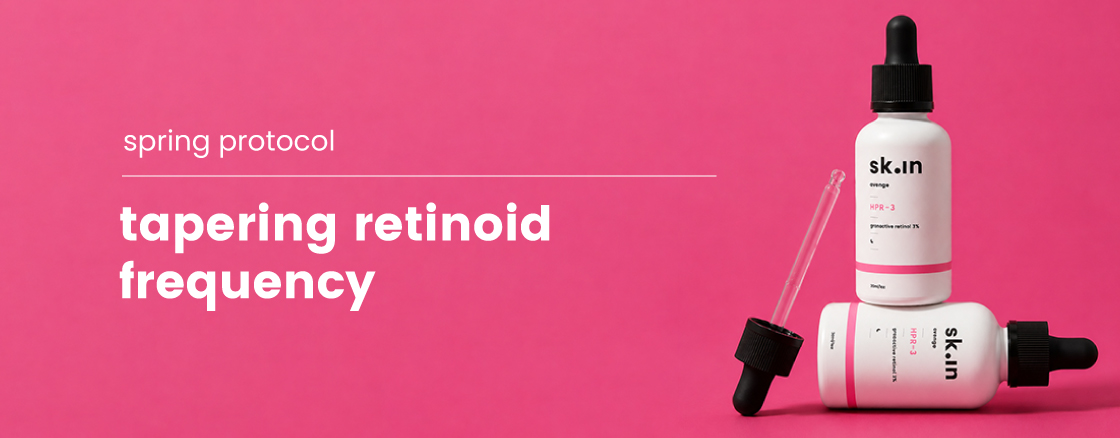

Tapering Retinoid Frequency: The HPR Spring Protocol
TL;DR:
Tapering retinoid frequency in spring, particularly by switching to a weekly HPR treatment, maintains cellular turnover efficacy whilst protecting barrier integrity against increased UV exposure and seasonal skin sensitivity.
Tapering retinoid frequency in spring, particularly by switching to a weekly HPR treatment, maintains cellular turnover efficacy whilst protecting barrier integrity against increased UV exposure and seasonal skin sensitivity.
- Spring UV intensity increases the irritation risk of nightly retinoid use — tapering frequency is a clinically sound response, not a compromise.
- HPR (Hydroxypinacolone Retinoate) is a retinoid ester that binds directly to retinoic acid receptors without requiring conversion, producing lower irritation potential than traditional retinol.
- A once- or twice-weekly HPR application at 3% concentration can maintain visible skin improvement whilst allowing the barrier to remain stable across seasonal transition.
- The HPR Spring Protocol involves reducing application frequency, not concentration — this preserves potency-tolerance balance whilst managing cumulative UV exposure risk.
- Signs of over-use include persistent redness, tightness, flaking, and increased sensitivity to other actives — all signals to reduce frequency before reducing strength.
In spring, tapering retinoid frequency reduces the risk of UV-sensitised irritation while maintaining cellular turnover. Switching from nightly retinol to a once- or twice-weekly application of HPR (Hydroxypinacolone Retinoate) preserves efficacy, supports barrier integrity, and aligns with the skin’s seasonal recalibration needs.
Spring is not the season to push your retinoid harder. It is the season to use it more intelligently. As UV intensity increases and the skin’s protective function shifts in response to changing environmental conditions, the nightly retinoid routine that served you through winter can become a liability rather than an asset. The question is not whether to continue using a retinoid in spring — it is how to restructure the frequency, format, and strength to maintain cellular turnover without compromising barrier integrity.
This article focuses specifically on HPR (Hydroxypinacolone Retinoate), a retinoid ester that offers a structurally different approach to retinoid use, and how to build a spring protocol around it that is both efficacious and seasonally appropriate. For the broader context of seasonal skin recalibration and how to structure a complete spring routine, the sk.in guide to building your spring skincare routine covers the foundational principles in full.
What follows is a focused, formulation-led protocol for skincare-literate individuals who already understand retinoids and want to use them with greater precision as conditions change.
—
Why Spring Changes the Retinoid Equation
How UV Intensity Interacts with Retinoid-Sensitised Skin
Retinoids accelerate cellular turnover. This is central to how they work and why they are valued in a performance skincare routine. Newer, less-keratinised cells are brought to the surface more rapidly, which supports a more refined skin texture and improved clarity over time. The clinical consequence of this mechanism is that the skin surface is, at any given point during active retinoid use, composed of cells that have had less time to develop full structural resilience.
This matters significantly in spring. As the Southern Hemisphere moves towards longer days and higher UV index readings, the skin that has been through a winter retinoid routine is entering a period of increased UV exposure with a surface layer that is more susceptible to UV-related stress. Research consistently indicates that retinoid use increases photosensitivity, and whilst daily SPF application addresses much of this risk, the cumulative effect of increased UV exposure combined with nightly retinoid use is a variable that warrants active management.
The practical outcome is a higher incidence of redness, reactivity, and what many users describe as “sensitised skin” during spring, even when the retinoid formulation has not changed. The retinoid is not the problem in isolation. The changed UV environment is the compounding variable.
What Seasonal Skin Recalibration Means for an Active Routine
Seasonal skin recalibration, in the context of an active routine, means adjusting the frequency and intensity of actives to match the skin’s current tolerance threshold and environmental load. It is not a pause in progress. It is a recalibration of the conditions under which progress continues.
For retinoid users, spring recalibration typically means reducing application frequency from nightly to two or three times per week, increasing the emphasis on barrier-supporting hydration on non-retinoid nights, and ensuring that SPF application is consistent and broad-spectrum. The goal is to maintain the cellular turnover benefits of retinoid use whilst reducing the cumulative sensitisation risk that comes from daily application during a period of increasing UV intensity.
This recalibration is not a step backwards. Skin that is well-supported, not over-activated, and consistently protected responds more effectively to actives over time than skin that is perpetually stressed and reactive.
—
HPR vs Traditional Retinol: Why the Molecule Matters in Spring
How HPR (Hydroxypinacolone Retinoate) Works Differently from Retinol
HPR (Hydroxypinacolone Retinoate) is a retinoid ester that binds directly to retinoic acid receptors in the skin without requiring enzymatic conversion. Traditional retinol must undergo a two-step conversion process inside the skin: retinol converts to retinaldehyde, and retinaldehyde converts to retinoic acid, which is the active form that binds to receptors and initiates cellular response. Each conversion step introduces the possibility of irritation and reduces the overall efficiency of delivery.
HPR bypasses this conversion pathway. It reaches the receptor in its active esterified form, which means the cellular response is initiated with less enzymatic processing, less intermediate metabolite production, and, as a result, a lower irritation profile than equivalent-strength retinol formulations. This is not a compromise on efficacy. It is a more direct delivery mechanism.
What Makes HPR a Retinoid Ester Rather than a Traditional Retinol
The distinction between a retinoid ester and traditional retinol is a formulation-level difference with real clinical significance. Retinol is an alcohol form of Vitamin A. It requires conversion to retinaldehyde and then to retinoic acid before it can engage with nuclear retinoic acid receptors. This conversion is enzymatically regulated and varies between individuals, which partly explains why retinol response is so inconsistent across different skin types.
HPR is an ester of retinoic acid. Its molecular structure allows it to interact with retinoic acid receptors more directly, and its ester bond contributes to greater formulation stability than retinol, which is notoriously prone to oxidation. In a spring context, where the goal is to maintain retinoid efficacy at reduced frequency, HPR’s direct receptor activity means that a once- or twice-weekly application can deliver a meaningful cellular signal without requiring the daily accumulation that retinol’s conversion-dependent mechanism often demands.
sk.in avenge | HPR 3% is formulated around this potency-tolerance balance, delivering HPR at a concentration that supports cellular turnover with lower irritation potential than traditional retinol at comparable activity levels.
—
The HPR Spring Protocol: How to Structure a Weekly Retinoid Treatment
How to Introduce a High-Strength Retinoid on a Reduced Schedule
The HPR spring protocol is built on a principle of strategic reduction: fewer applications, maintained efficacy, reduced cumulative sensitisation. For someone transitioning from nightly retinol use, the shift to twice-weekly HPR represents both a frequency reduction and a molecular upgrade.
A structured starting point for spring is two applications per week, separated by at least two nights to allow the skin’s surface to stabilise between treatments. Application on a Tuesday and Friday evening, for example, creates a consistent rhythm without clustering applications too closely. On the remaining evenings, the routine should prioritise barrier-supporting hydration, with a focus on structural hydration rather than additional actives.
The evening application sequence for HPR use follows standard retinoid layering intelligence: cleanse, apply any water-based serum first if layering, apply HPR as the treatment step, and follow with a hydration serum to support barrier integrity overnight. Avoid applying HPR immediately after an acid toner or exfoliating step on the same evening.
Can You Combine an Acid and a Retinoid in the Same Routine?
This is one of the most frequently asked questions in retinoid education, and the answer requires nuance rather than a blanket rule. Acids and retinoids are not inherently incompatible, but combining them in the same application sequence during spring significantly increases the risk of sensitisation, particularly on skin that is already managing increased UV exposure.
The practical recommendation for a spring protocol is to separate acid and retinoid use onto different evenings entirely. If glycolic acid (AHA exfoliant) is part of the weekly treatment layer, schedule it on a non-HPR evening. This separation allows each active to perform within a skin environment that is not simultaneously managing the effects of another potent ingredient.
If a single-evening combination is unavoidable, the lower-risk approach is to apply the acid first, allow full absorption, and apply the retinoid afterwards, with a buffer of at least twenty minutes between steps. This approach is not recommended as a default for spring use, but it is a more considered option than simultaneous application.
Using HPR as a Retinoid Spot Treatment: What the Evidence Suggests
HPR’s direct receptor activity and lower irritation profile make it a viable candidate for targeted application on specific areas of concern rather than full-face use. This approach is particularly relevant in spring for individuals with uneven skin reactivity, where certain areas (typically the cheeks and perioral zone) are more sensitised than others.
Applying HPR as a targeted treatment to areas of visible texture, congestion, or cellular turnover concern, whilst avoiding already-sensitised zones, allows the retinoid protocol to continue without aggravating areas that need a period of reduced activation. This is not a permanent adjustment, but a seasonally intelligent one that reflects the skin’s current state rather than an idealised protocol.
—
Signs You Are Using a Retinoid Too Often and How to Respond
The clearest signs of retinoid overuse are persistent redness that does not resolve within 24 hours of application, visible surface dryness that does not respond to hydration, a stinging or burning sensation during application of otherwise well-tolerated products, and increased sensitivity to products that previously caused no reaction. These signs are distinct from the initial adjustment phase that accompanies first-time retinoid use.
Retinoid overuse in spring often presents differently from winter overuse. In winter, the primary symptom is dryness and flaking. In spring, the compounding effect of UV exposure means that overuse more frequently presents as persistent low-grade redness and a generalised increase in skin reactivity. The skin appears irritated rather than simply dry.
When these signs appear, the appropriate response is to pause retinoid application for a minimum of five to seven nights, focus the routine on barrier function support through hydration-focused serums, and reintroduce the retinoid at a reduced frequency once the signs of reactivity have resolved. Reducing concentration at this stage is less important than reducing frequency.
The Difference Between Retinoid Adjustment and Retinoid Failure
Retinoid adjustment is a temporary period of skin response to a new active or a new concentration. It is characterised by mild, transient redness or dryness that resolves between applications and does not worsen over successive weeks. Retinoid failure, by contrast, is a persistent and worsening response that does not improve with time and indicates that the current formulation, frequency, or concentration is not compatible with the skin’s current tolerance threshold.
The distinction matters because the response to each is different. Adjustment warrants patience and barrier support. Failure warrants a protocol review, which may mean reducing frequency, switching to a lower-concentration formulation, or pausing retinoid use entirely whilst barrier integrity is re-established. Spring is a season when genuine retinoid failure is more common than at other times of year, precisely because the UV-sensitisation variable is added to an already-demanding active routine.
—
When to Move Up Retinoid Strength and What That Looks Like with HPR
How Long Before a Retinoid Produces Visible Improvement?
Retinoid-mediated cellular turnover operates on a cycle that reflects the skin’s natural renewal timeline. Research and clinical experience consistently indicate that visible improvement in skin texture and clarity typically becomes apparent after six to eight weeks of consistent use, with more substantive changes in the appearance of fine lines and surface irregularities requiring twelve weeks or more of sustained application.
This timeline applies to HPR as it does to other retinoids, with the important caveat that HPR’s direct receptor activity means the cellular signal is initiated more efficiently per application. This does not translate to faster visible results in a linear sense, but it does mean that a twice-weekly HPR protocol can maintain meaningful retinoid activity over a spring season without requiring the daily application frequency that traditional retinol often demands to achieve comparable receptor engagement.
Patience within a structured protocol is not passivity. It is the recognition that skin improvement is a cumulative process that rewards consistency over intensity.
Moving from Nightly Retinol to a Weekly High-Strength Treatment: A Structured Transition
The transition from nightly retinol to a twice-weekly HPR protocol is a meaningful shift in retinoid strategy, not simply a frequency reduction. It involves changing both the molecular form of the retinoid and the application rhythm, which requires a structured approach to avoid an inadvertent gap in cellular turnover support.
The recommended transition sequence is as follows. In the first week, reduce retinol application to every other night whilst introducing one HPR application on a non-retinol evening. This creates an overlapping transition period where both molecules are active but neither is being applied at maximum frequency. In the second week, discontinue the retinol and move to two HPR applications per week on non-consecutive evenings. By the third week, the HPR protocol is the sole retinoid in the routine, and the frequency and timing can be refined based on how the skin is responding.
This graduated transition prevents the abrupt removal of retinoid stimulus that can occur when a nightly retinol is simply stopped, and it allows the skin to acclimate to HPR’s direct receptor activity without the shock of a sudden high-concentration introduction.
Progression to increased HPR application frequency, or to a higher-concentration formulation, should be considered only when the twice-weekly protocol has been maintained for a full eight weeks without signs of reactivity, and when the skin’s response to the current protocol is clearly settled. Spring is rarely the right season to increase retinoid intensity. It is the season to consolidate and maintain.
—
Building the Protocol Into a Settled Spring Routine
The HPR spring protocol is most effective when it sits within a routine that has been structured with the same layering intelligence applied to every other active. Antioxidant protection in the morning, consistent broad-spectrum SPF, and barrier-supporting hydration on non-retinoid evenings form the complementary framework that allows HPR to perform without the compounding sensitisation risk that comes from an unstructured active routine.
For those interested in how antioxidant use integrates with the spring transition, why spring is the window to build antioxidant habits provides a detailed framework for morning antioxidant layering that works alongside a retinoid-focused evening protocol.
The protocol in summary: twice-weekly HPR application on non-consecutive evenings, barrier-supporting hydration on remaining evenings, acids scheduled on separate nights from HPR, morning antioxidant and SPF as non-negotiable daily steps. This is not a reduced routine. It is a seasonally calibrated one.
—
Frequently Asked Questions
How often should you use a retinoid in spring?
In spring, tapering retinoid frequency reduces the risk of UV-sensitised irritation while maintaining cellular turnover. Switching from nightly retinol to a once- or twice-weekly application of HPR (Hydroxypinacolone Retinoate) preserves efficacy, supports barrier integrity, and aligns with the skin’s seasonal recalibration needs.
Is HPR used every night like traditional retinol?
No. HPR’s direct receptor activity means that meaningful cellular turnover support can be maintained at a lower application frequency than traditional retinol. A twice-weekly protocol is appropriate for spring use and is preferable to nightly application when UV exposure is increasing.
What are the signs that you are using a retinoid too often?
Persistent redness that does not resolve within 24 hours, surface dryness unresponsive to hydration, stinging during application of well-tolerated products, and generalised increased skin reactivity are the primary indicators of retinoid overuse. These signs warrant a pause of five to seven nights followed by reintroduction at reduced frequency.
Can you use an acid and a retinoid in the same routine?
Acids and retinoids are best scheduled on separate evenings during spring. If both are part of the weekly treatment layer, alternating their application nights reduces the risk of compounded sensitisation. Simultaneous same-evening application is the least preferred approach during a period of increased UV exposure.
How long does it take for a retinoid to produce visible results?
Clinical experience and research indicate that visible improvement in skin texture and clarity typically becomes apparent after six to eight weeks of consistent retinoid use. More substantive changes in the appearance of fine lines and surface irregularities generally require twelve weeks or more of sustained application.
—
Explore sk.in avenge | HPR 3% for a doctor-formulated retinoid ester built around the potency-tolerance balance, independently tested over 8 weeks at Luamed (Slovenia, 2019).
Related Articles
- The sk.in Guide to Your Spring Skincare Routine
– Parent pillar. Provides the foundational spring routine framework that this cluster article deepens specifically around retinoid tapering and HPR protocol. - Why Spring Is the Window to Build Antioxidant Habits
– Sibling cluster. Antioxidant protection and retinoid tapering are complementary spring strategies — increased UV exposure is the shared rationale for both adjustments.
You must be logged in to post a comment.